At a glance
- What it is
- Scattered remains of a mining town on the Yankee Boy Basin road, beyond the Camp Bird Mine.
- The story
- Its silver mine kept flooding, so miners dug the Revenue Tunnel to reach the vein 2,400 feet below where it showed at the surface.
- Getting there
- Southwest of Ouray. Private mine land and homes line the road, so stay on it. Closed December 1 to April 30; best July to September.
A silver mine 12,300 feet up the mountain above Sneffels had a problem no pump was going to fix: it kept filling with water. The answer took years, 500 men and a hole more than two miles long. I'll make you wait for it, because the people who lived here had to wait too.
A town named after a novel, then after a storekeeper
In 1874 Frederick M. Endlich, a geologist with the Hayden Survey (the government team mapping this part of the West), named the big peak here after Snaefell. That's the Icelandic volcano where the characters in Jules Verne's Journey to the Center of the Earth start their trip down. On September 10, 1874, Franklin Rhoda's survey team climbed it. Rhoda's review of the summit was mostly about elbow room.
The peak is so sharp that there is no room for more than two or three persons to stand on the very top.Franklin Rhoda, Hayden Survey, after the September 10, 1874 climb (as quoted by the Ouray News, 2026)
A year later a mining camp went up on the mountain's south face, at about 10,650 feet. It was first called Porters, after George Porter, who ran the store. That's rural naming at its finest, the same system that gives you a gravel road called Miller Lane because a Miller has lived at the end of it since forever. The post office opened in 1879 as Mount Sneffels and got trimmed to Sneffels in 1895.
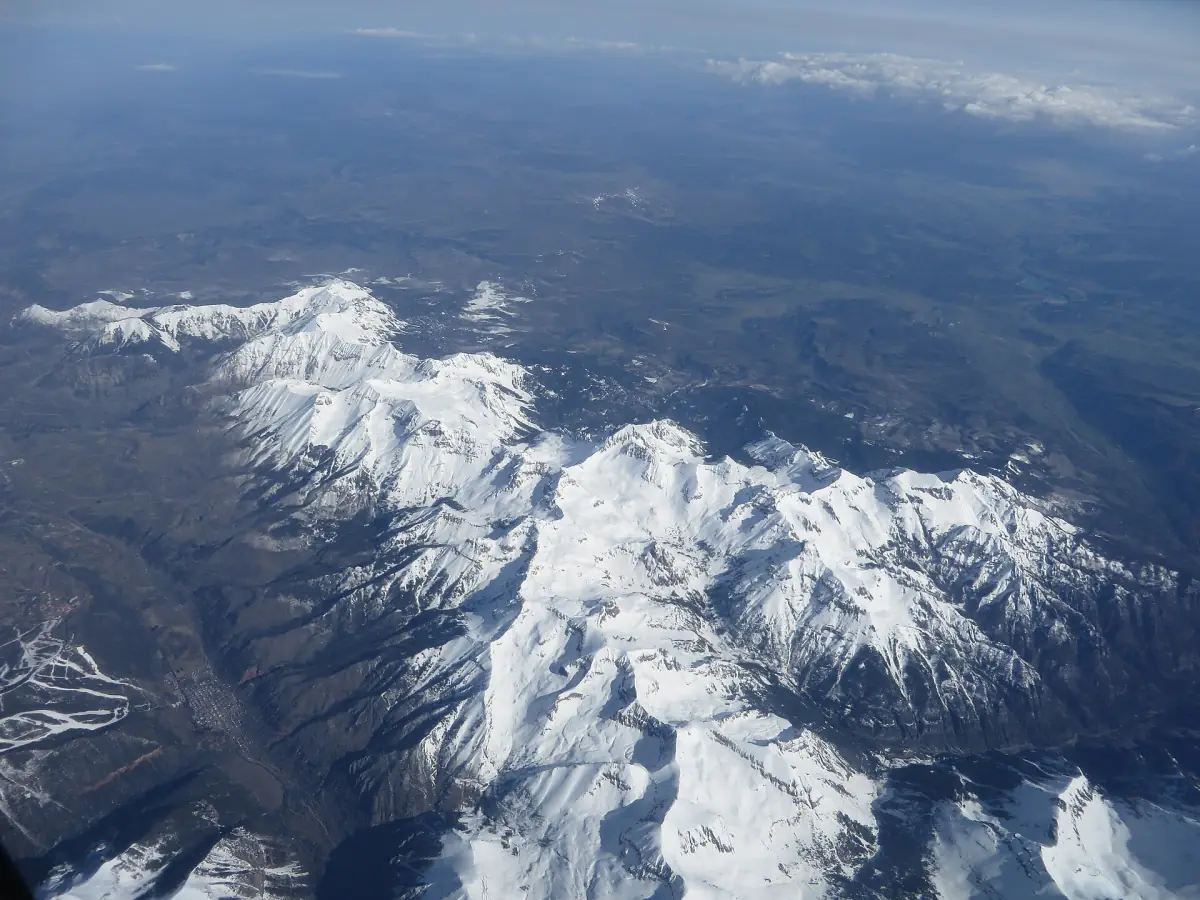
A silver mine at 12,300 feet that kept flooding
In 1880 Albert E. Reynolds and John H. Maugham bought the Virginius Mine, about 2,000 feet above town. It got a four-story boarding house and, from 1887 to 1894, its own post office. The mine had a mailing address. On a cliff.
The Virginius kept flooding, and water in a mine shaft has one way out: back up the same shaft you're trying to work in. That is a bad setup for a silver mine.
Snow was the other problem. In December 1883 avalanches hit the Virginius boarding house and killed four of the twelve men inside. A second avalanche hit the 32 men sent up to help and buried the sleds carrying the bodies.
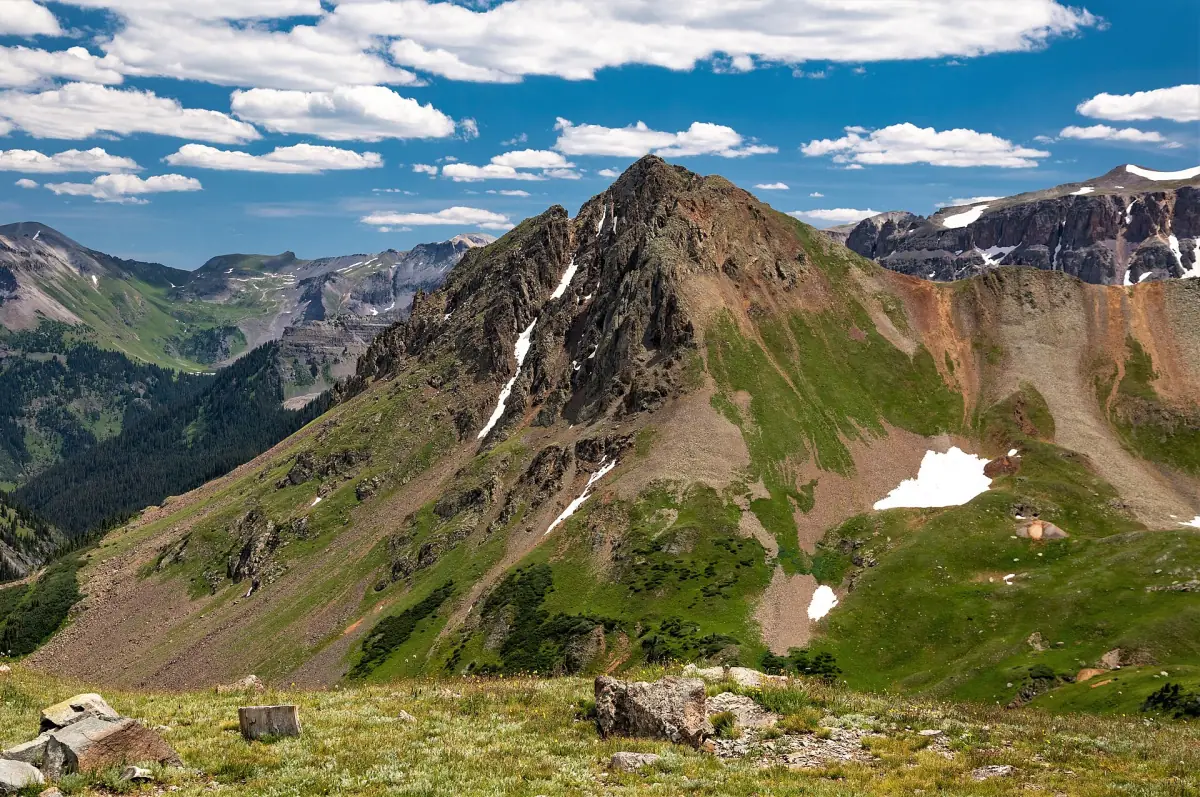
The answer was a tunnel called the Revenue
Here's the fix. In 1888 or 1889 (the sources split on the year), crews started a tunnel at the town and aimed it at the bottom of the Virginius. They called it the Revenue Tunnel, and it put 500 men to work. The plan was easy to say and brutal to do. Get under the mine, and let the water and the ore come down to you.
If you've ever owned a Jeep with floor drain plugs, you already get it. You can bail a flooded floor with a cup, or you can pull the plug and let gravity handle it. The Revenue Tunnel was a drain plug more than two miles long.
It was finished in 1896. It hit the Virginius vein 2,400 feet below where the vein showed at the surface. Water drained out on its own, and ore rolled by gravity down to the mill at Sneffels. By 1903, with a shaft sunk 900 feet below the tunnel, the workings spanned 3,300 vertical feet. T. A. Rickard, who wrote a 1903 book about these mountains, called them the deepest in Colorado.
Six stories of mill and a bare wire at head height
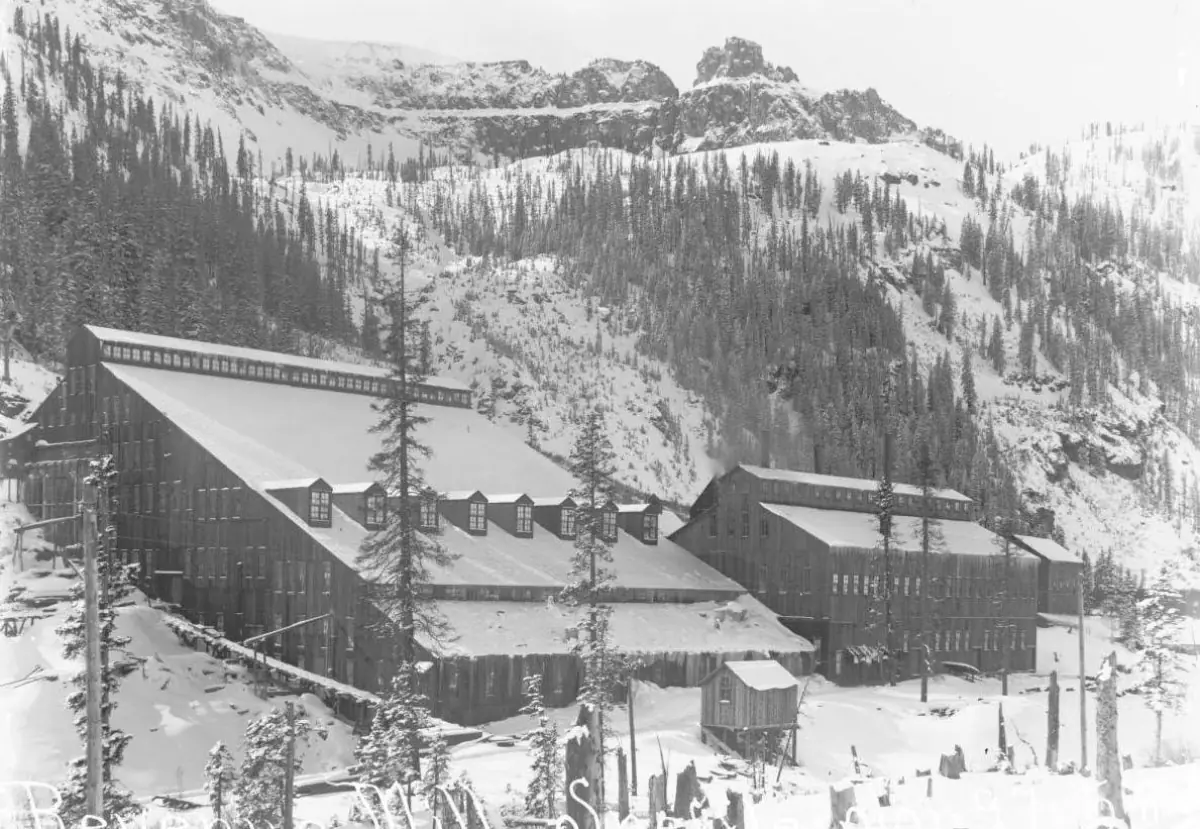
The boom years were big. The six-story Revenue Mill, 180 by 80 feet, turned out 40 to 50 tons of concentrate (crushed, cleaned-up ore) a day and employed about 600 men. Three boarding houses had electric lights, indoor plumbing and steam heat. The town peaked at about 2,000 people, with a school and a brass band.
The electricity underground was less cozy. Here's Rickard on the mine cars in the Virginius, and I swear this is a real quote.
The electric cars used for underground traction are remarkable in taking the high pressure of 800 to 900 volts from a bare wire placed about the height of a man's head.T. A. Rickard, Across the San Juan Mountains, 1903
Nine hundred volts. Bare. At head height. Tall guys had to really want that job. Up top, the water running the mill's Pelton wheels (water turbines) carried so much sand from mill waste that it wore out the nozzles in ten days. In fall 1900 a smallpox quarantine shut the town and the nearby mines.
In 1915 fire destroyed the Revenue Mill. One source says August and another says September. Either way, it was the beginning of the end. The mill and tunnel sold to the Tomboy Gold Mines Company in 1919, and the district was mostly idle by the 1930s. Sources credit the mines with $27 million to $28 million in production.
Two miners killed in 2013
The mine didn't stay closed. Star Mine Operations bought the Revenue-Virginius in late 2011 and reopened it. On November 17, 2013, after a blast underground, miners Nick Cappanno, 34, and Rick Williams, 59, died of carbon monoxide. At least 19 others were sickened.
Visiting Sneffels today
Sneffels sits on the road to Yankee Boy Basin, past the Camp Bird Mine, and the Governor Basin and Imogene Pass routes run through the same area. Only scattered remains and a few nearby residents are left. Near the road's end you'll see what's left of a mine building and a big tailings pile (the waste rock and sand from milling). The Revenue-Virginius is a private mine site, not a museum, and the sources I read don't confirm whether it's working right now. Stay on the road, and leave the driveways alone.