At a glance
- What it is
- An 11,781-foot stone pillar just south of Owl Creek Pass.
- The story
- It stands behind John Wayne in the final shootout of True Grit. The only climbing route is still the 1934 line up its 400-foot south face.
- Getting there
- About 15 miles up Owl Creek Pass Road from near Ridgway, maintained gravel suitable for regular cars. You can see it from the road.
You've seen Chimney Rock, even if you don't know its name. It is the giant stone pillar standing behind John Wayne in the final shootout of True Grit, the role that won him his only competitive Oscar. The rock's real story starts 34 years before the cameras showed up, with two climbers and one crack in its south face.
The True Grit shootout under Chimney Rock
True Grit was filmed mostly in Ouray County, from September to December of 1968. The big finish happens in a mountain meadow near Owl Creek Pass. Rooster Cogburn squares off with Ned Pepper's gang across the grass, and Chimney Rock fills the sky behind them.
If you remember Rooster's line as "Fill your hands," you're one letter off. It's "Fill your hand," singular, and he finishes the sentence with words this family trail guide is not going to print. Ned Pepper's setup line is clean, so here it is in full.
I call that bold talk for a one-eyed fat man!Ned Pepper, True Grit (1969), as quoted by Joe Leydon, Cowboys & Indians, 2019
The movie opened June 13, 1969, and Wayne won Best Actor for it. Think of the meadow as the stadium and Chimney Rock as the scoreboard. Every fan in the place looks up at it. Nobody ever hands the scoreboard a trophy.
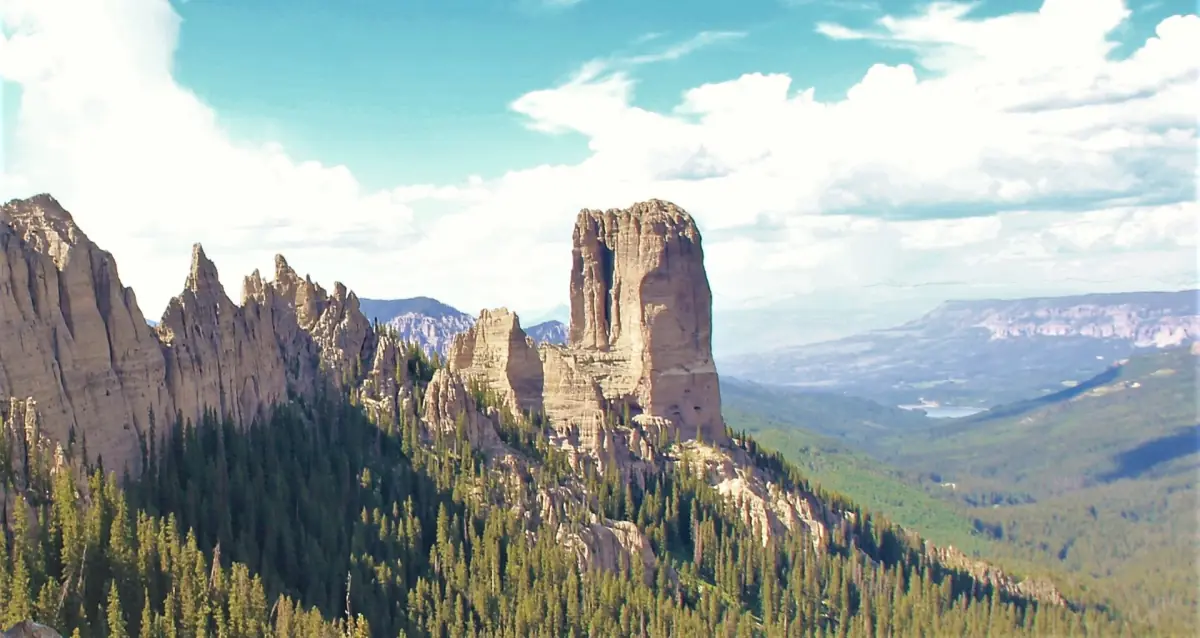
Seven years earlier, Gregory Peck and a stuck wagon
True Grit wasn't the rock's first movie. In 1962 it showed up in How the West Was Won, in the scene where Gregory Peck tries to tow a covered wagon out of the mud. Same skyline, two Hollywood westerns, seven years apart. Plenty of actors never land two big westerns. This rock did it by standing still.
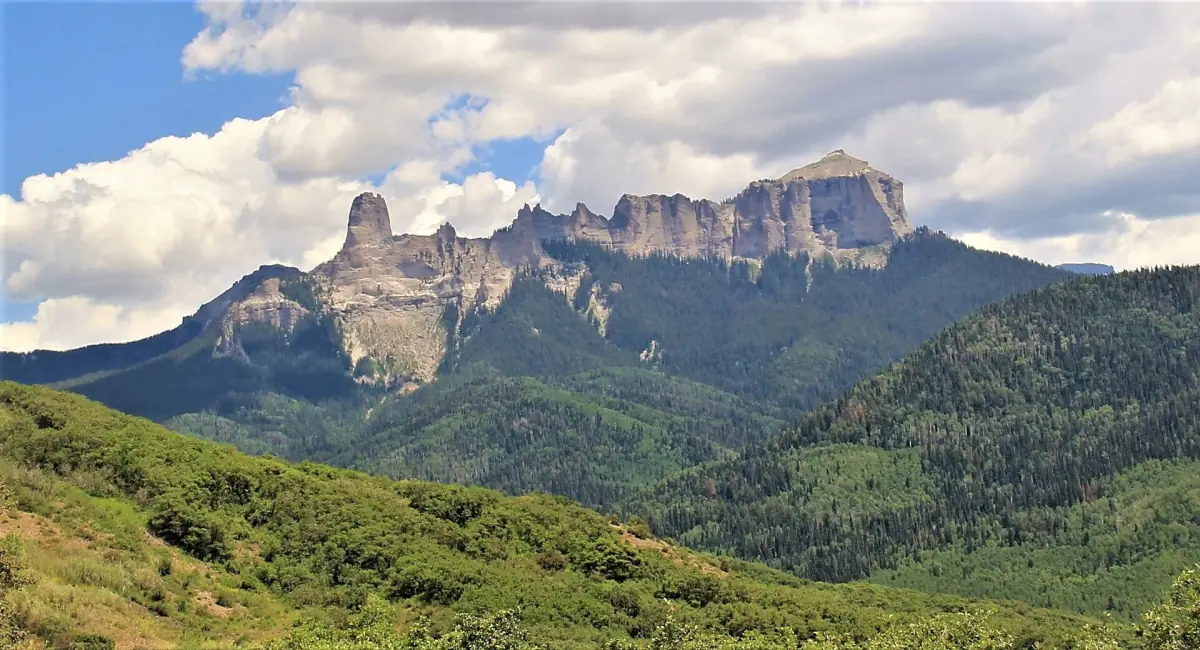
The most difficult peak in Colorado, until 1934
Before Hollywood found it, climbers had their own reputation for this thing. Colorado climbers often called it "the most difficult peak in Colorado." Look at it and you get why. The east side rises 1,600 feet above the West Fork of the Cimarron River in half a mile, and the top is a pillar that's vertical on every side.
The rock is conglomerate, which is a geology word for gravel and stones that nature cemented together. Picture a bag of concrete mix from the hardware store that set up hard and then got stood on end, 400 feet tall. Somebody had to climb that.
On September 15, 1934, two young members of the San Juan Mountaineers, T. Melvin Griffiths and Robert Ormes, did. They worked up a chimney and crack that splits the south face and stood on top. The American Alpine Journal's Colorado notes that year described it like this.
This 11,782-ft. pinnacle, absolutely vertical on all sides, was climbed by a chimney and crack splitting the south face of the rock.Carleton C. Long, Colorado Climbing Notes, American Alpine Journal, 1934
The same report called the rock "well cemented conglomerate presenting firm holds" and the climbing "uniformly of high difficulty." Translation: the handholds were solid and every single move was hard. Two guys topping out on the tower climbers called the hardest peak in the state, in 1934, is gangster. (Wikipedia lists the rock at 11,781 feet. The 1934 report said 11,782. You can measure twice and still disagree by a foot.)
Wikipedia calls it the first ascent. The 1934 report never uses those words. It just says the peak "yielded its summit," which is how you'd describe a team that finally lost at home. And here's the kicker. One month later, in October 1934, Ormes was over in the Sneffels area helping Fox Movietone News film a mountaineering short. One of the two guys who climbed the rock got into the movie business 34 years before the rock did.
Chimney Peak gets an official name
For most of its life the rock went by Chimney Peak. That's what the 1934 report calls it. In 1966 the U.S. Board on Geographic Names made Chimney Rock the official name. Nothing about the rock changed. Somebody just put a new label on the drawer, like finally marking the coffee can of mystery screws in the garage.
Visiting Chimney Rock today
Chimney Rock is easy to see and hard to touch. You can spot it from US 550 near Ridgway. For the close-up, take Owl Creek Pass Road (Ouray County Road 10) east from US 550, about 1.7 miles north of Ridgway's traffic light. The pass is about 15 miles in, at 10,114 feet, and Chimney Rock stands immediately south of it. Deb's Meadow, where the True Grit shootout was filmed, is just northwest of the pass.
The Montrose visitor guide calls the Owl Creek Pass road a maintained gravel road suitable for conventional cars, so this is one of the gentler drives on this site. Check conditions before you go. Off the road you're in the Uncompahgre Wilderness, where motors and bikes aren't allowed. The top is still off the table for most of us. The only established route is that same 400-foot south face crack from 1934, and it's a technical rock climb. Bring a camera and leave the climbing shoes in the truck.